
Inaugural
Feb 11- 9:30- 10:15 pm (SLASS Auditorium )
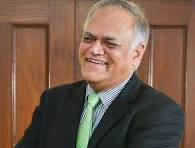
Javed Jabbar
Javed Jabbar is a renowned Pakistani polymath—an award-winning filmmaker, prolific writer, policy analyst, and former Federal Minister and Senator. With a career spanning over five decades, he is a central figure in Pakistan’s media and political history, having served in three federal cabinets with portfolios including Information, Petroleum, and Science & Technology. He is a trailblazer in cinema, having written and directed Pakistan’s first English-language feature film, Beyond the Last Mountain (1976), and produced the critically acclaimed Ramchand Pakistani (2008).
A public intellectual with a deep interest in national identity, Jabbar has authored 21 books, including best-selling political memoirs like But, Prime Minister… and his seminal work What is Pakistaniat?. In March 2025, his lifelong contributions to literature and public service were recognized with the Hilal-i-Imtiaz, Pakistan’s second-highest civilian honor. He remains active in voluntary development work, having served as Global Vice President of the International Union for Conservation of Nature (IUCN) and as a long-standing participant in the Neemrana Initiative, a Track-II diplomatic dialogue between Pakistan and India

Svetlana S. Bodrunova
Svetlana S. Bodrunova is Professor of Communication at St. Petersburg State University, Russia. She has published two books and 100+ research papers in English, German, and Russian, including those in Journalism, Social Media + Society, International Journal of Communication, Media and Communication, and Journalism Practice. Her research interests include Russian and European journalism, media and politics, social media, and computational methods in communication. She leads the Center for International Media Research in her university and chairs the conference ‘Comparative media studies in today’s world’ (CMSTW).
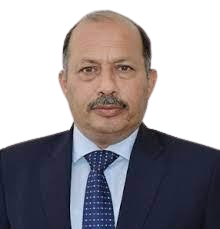
Ambassador (R) Mansoor Ahmad Khan
Ambassador (R) Mansoor Ahmad Khan is a career diplomat currently serving as the Director of the Beaconhouse Centre for Policy Research (BCPR) and Head of the “Initiative on Pakistan’s Place in the World”. With over 32 years of experience in the Foreign Service of Pakistan, he has held high-profile roles including Ambassador to Afghanistan (2020–2022) during the pivotal U.S. withdrawal, Ambassador to Austria, and Pakistan’s Permanent Representative to the United Nations in Vienna. His expertise spans regional diplomacy and economic integration, having also served in major missions in New Delhi, Kabul, and Geneva. A recipient of the Sitara-e-Shujaat, he now leads strategic research at BCPR, focusing on local governance reforms and Pakistan’s role in global geopolitical competitions.
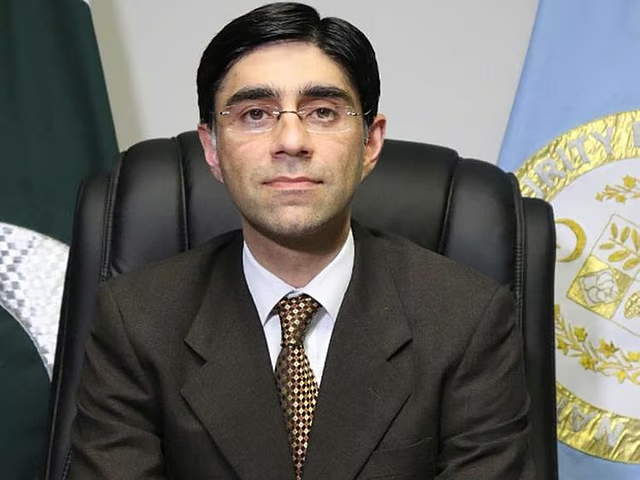
Dr. Moeed Yusuf
Dr. Moeed Yusuf is the Vice-Chancellor of Beaconhouse National University (BNU) and a Senior Fellow at the Harvard Kennedy School’s Belfer Center. He previously served as Pakistan’s youngest National Security Adviser (2021–2022) and held leadership roles at the United States Institute of Peace (USIP). An expert in South Asian security with a PhD from Boston University, he has authored several books, including Brokering Peace in Nuclear Environments. Since joining BNU, he has been recognized as a Visionary Leader of Pakistan and spearheaded the university’s transition to becoming a WWF-certified Green Campus.
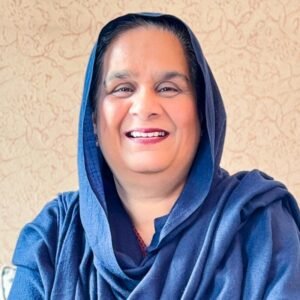
Prof. Dr. Bushra Hameedur Rahman
Prof. Dr. Bushra Hameedur Rahman is a distinguished academic leader and media researcher currently serving as the Dean of the School of Media and Mass Communication at Beaconhouse National University (BNU). With a career spanning over three decades, including her tenure as Chairperson of Journalism Studies at the University of the Punjab, her research extensively examines the representation of Muslim women in international magazines like Time and Newsweek and the framing of women in Pakistani politics. She utilizes critical discourse analysis to challenge Orientalist stereotypes and advocate for a nuanced understanding of Muslim feminism, while also exploring media ethics and peace journalism to foster societal cohesion. Recently, she has pioneered the integration of Allama Muhammad Iqbal’s philosophy into communication studies, focusing on ethical digital ecologies. As the founder and president of AMCAP and a prominent member of the IAMCR, she remains a vital force in bridging Pakistani scholarship with global academic standards and emerging technologies.
Closing
Feb 12- 3:15- 4:15 pm (SLASS Auditorium )
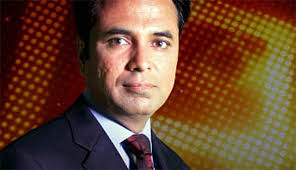
Talat Hussain
Syed Talat Hussain is a distinguished journalist and YouTuber, renowned for his incisive analysis and significant contributions to Pakistani media. He holds a master’s degree from Quaid-i-Azam University, Islamabad, and began his journalism career in the 1990s. Over the years, he has become a respected figure in the industry.Talat has held several key positions, including Executive Director of News and Current Affairs at AAJ TV. He has also worked with major networks such as PTV, Dawn News, and Geo News. Currently, he hosts a prime-time current affairs talk show on Samaa TV titled ‘Red Line with Talat.’ He is also known for his contributions to print media, having written for publications like Newsline, Daily Dawn, and Daily Times.
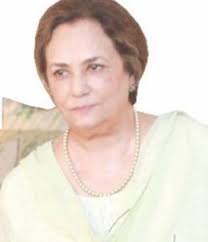
Navid Shahzad
Navid Shahzad is a legendary Pakistani polymath whose career spans over five decades as a pioneering actress, academic, and author. Stalemate: a chronicle of love and despair which is a collection of her journalistic work is her second book launched at the Lahore Literary Festival 2026 A recipient of the prestigious Pride of Performance award, she first gained national fame for her satirical performances in 1970s classics like Such Gup before later appearing in modern hits like the film Punjab Nahi Jaungi. Beyond the screen, she is a trailblazer in education, having served as a professor at the University of the Punjab and as the Dean at Beaconhouse National University, where she founded Pakistan’s first Theatre, Film, and TV department. The daughter of former Chief Justice S.A. Rahman and mother of the late musician Farhad Humayun, she remains a formidable intellectual force, recently publishing her acclaimed book, Aslan’s Roar, on Turkish television culture, along with Stalemate: a chronicle of love and despair which is a collection of her journalistic work is her second book launched at the Lahore Literary Festival 2026.
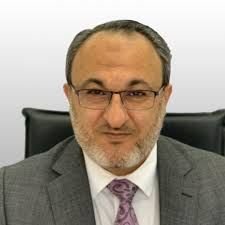
Mr. Mohammad Makram Omar Moh’d Balawi
Dr. Mohammad Makram Omar Moh’d Balawi is a distinguished Jordanian-Palestinian scholar, writer, and public intellectual with a robust record in international affairs and advocacy. He holds a PhD in English Literary Studies and has taught at universities in the Middle East. He is the founder and president of the Asia Middle East Forum, Director General of the League of Parliamentarians for Al-Quds, and acting president of the Union of Palestinian Academics. A prolific author of books and articles, his work focuses on Asian relations and the Palestinian cause. Dr. Balawi’s writings have been translated into multiple languages, and he regularly contributes to global discussions on geopolitics and justice.
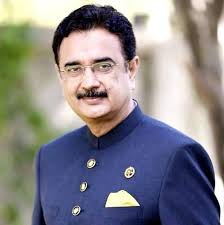
Professor Dr. Muhammad Ali
Professor Dr. Muhammad Ali is the 64th Vice Chancellor of the University of the Punjab, appointed in 2024. A renowned academician, he holds a Ph.D. from the University of Wales, UK and post-doctoral credentials from the University of Missouri, USA. He is one of Pakistan’s most experienced administrators, having led Quaid-i-Azam University and GCU Faisalabad as Vice Chancellor. For his vast contributions to biological sciences and higher education, he has been honored with both the Tamgha-e-Imtiaz and Sitara-e-Imtiaz. Currently, he focuses on merit-based reforms, financial sustainability, and integrating AI into university curricula to modernize Pakistan’s oldest seat of learning.Dr. Muhammad Ali serves as the Vice Chancellor of the University of the Punjab, one of Pakistan’s oldest and largest universities. In his role, he leads academic and administrative initiatives across the institution and represents the university in national educational forums.
InkWave
Feb 11- 4:00- 5:30 pm (SLASS 120 )
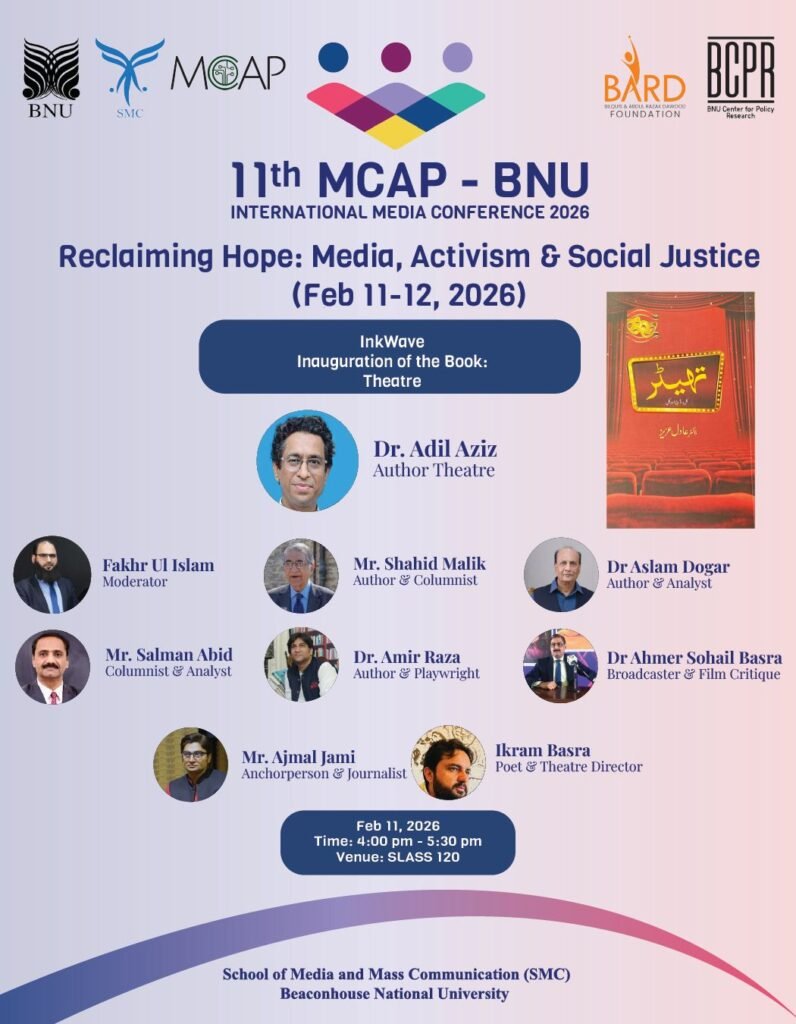
InkWave, an initiative of MCAP, is dedicated to encouraging, supporting, and mentoring scholars and practitioners in the field of media and communication to publish both in traditional and digital formats. The initiative responds to the pressing need to strengthen indigenous knowledge production, empower local authors, enrich media and communication studies, and present Pakistani scholarship to global audiences.
In alignment with these objectives, this session will be organized in two parts. The first part will mark the inaugural launch of the book “Theatre: Yesterday, Today and Tomorrow” by Dr. Adil Aziz, released in December 2025. The book offers a comprehensive and chronological account of the evolution of theatre, integrating global traditions with an in-depth exploration of Pakistani theatre up to 2020. Drawing on insights from theatre practitioners, the work highlights theatre’s social, cultural, and historical significance within Pakistan.
The second part of the session will focus on book publishing in Pakistan, bringing together publishers from across the country to share their experiences, challenges, and success stories. Through dialogue between authors and publishers, the session aims to demystify publishing pathways, discuss issues of visibility, distribution, and marketing, and strengthen the Author–Publisher Network under InkWave. Collectively, the session seeks to inspire prospective authors, foster sustainable publishing practices, and contribute to the growth of locally produced academic and cultural literature.
Workshop: Han” (汉 / 漢) Pixels- Chinese Art in the Digital Age ( Room No: SLASS 118)
This workshop introduces participants to Chinese art and culture through the use of contemporary digital tools, offering a creative space where traditional aesthetics intersect with modern artistic techniques. By engaging with visual styles and cultural motifs inspired by Chinese art, participants will explore new forms of creative expression while developing practical digital art skills. The workshop aims to foster cultural exchange and artistic dialogue, encouraging participants to experiment creatively and gain a foundational understanding that can support further learning and advanced practice. Designed for students, young professionals, and art and design enthusiasts, the program is also well suited for individuals interested in culture, creativity, and digital media.
Javednama AI Movie: A Visual Rendering of Iqbal’s Philosophical Epic
Feb 11- 2:15- 3:45 pm (SLASS Studio 125 )
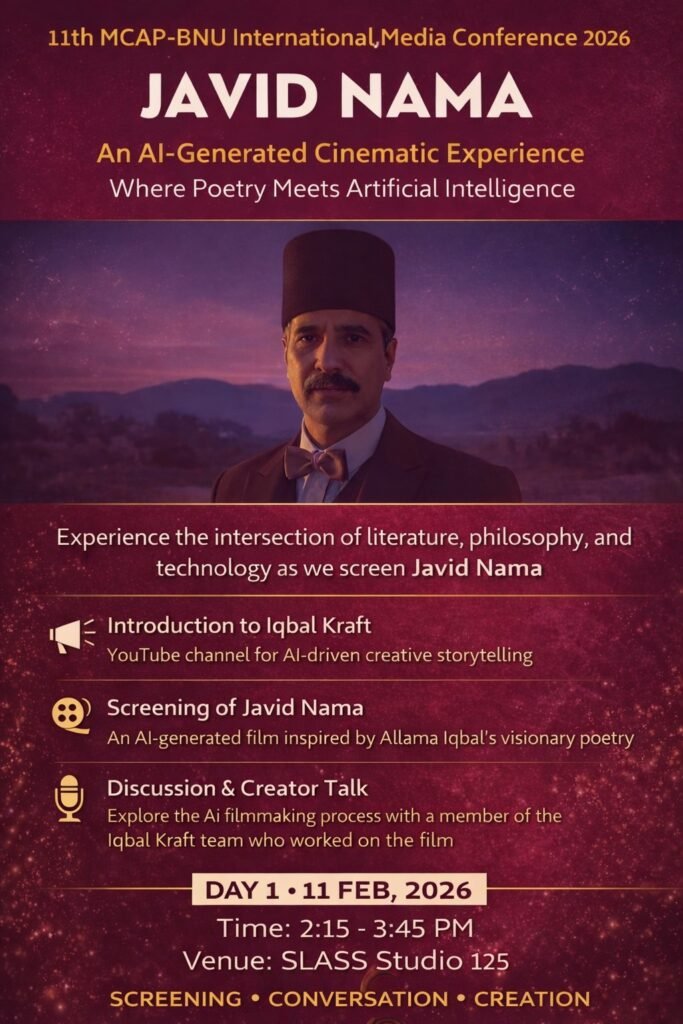
This special session features the Javednama AI Movie, an AI-generated cinematic rendering of Allama Iqbal’s philosophical epic Javednama. The film translates Iqbal’s poetic dialogue on human agency, moral responsibility, and world-making into a visual narrative, using artificial intelligence as a creative medium. It foregrounds Iqbal’s central idea that humanity possesses the capacity and the responsibility to transform the world, and that meaningful change begins with human initiative.
Hosted within the Visual Section of the conference, the session will begin with a collective screening of the film, followed by an interactive discussion. Participants will be invited to reflect on how classical philosophical texts can be re-presented through emerging technologies, and how AI-mediated storytelling reshapes our engagement with ideas of creativity, ethics, and hope. The session aims to create a reflective space where viewers can experience the film aesthetically while critically engaging with its intellectual and cultural implications in the contemporary digital age.
WG VI: AGON- Constructions of Democracy
Feb 12- 12:15- 12:45 pm (SLASS 211 )
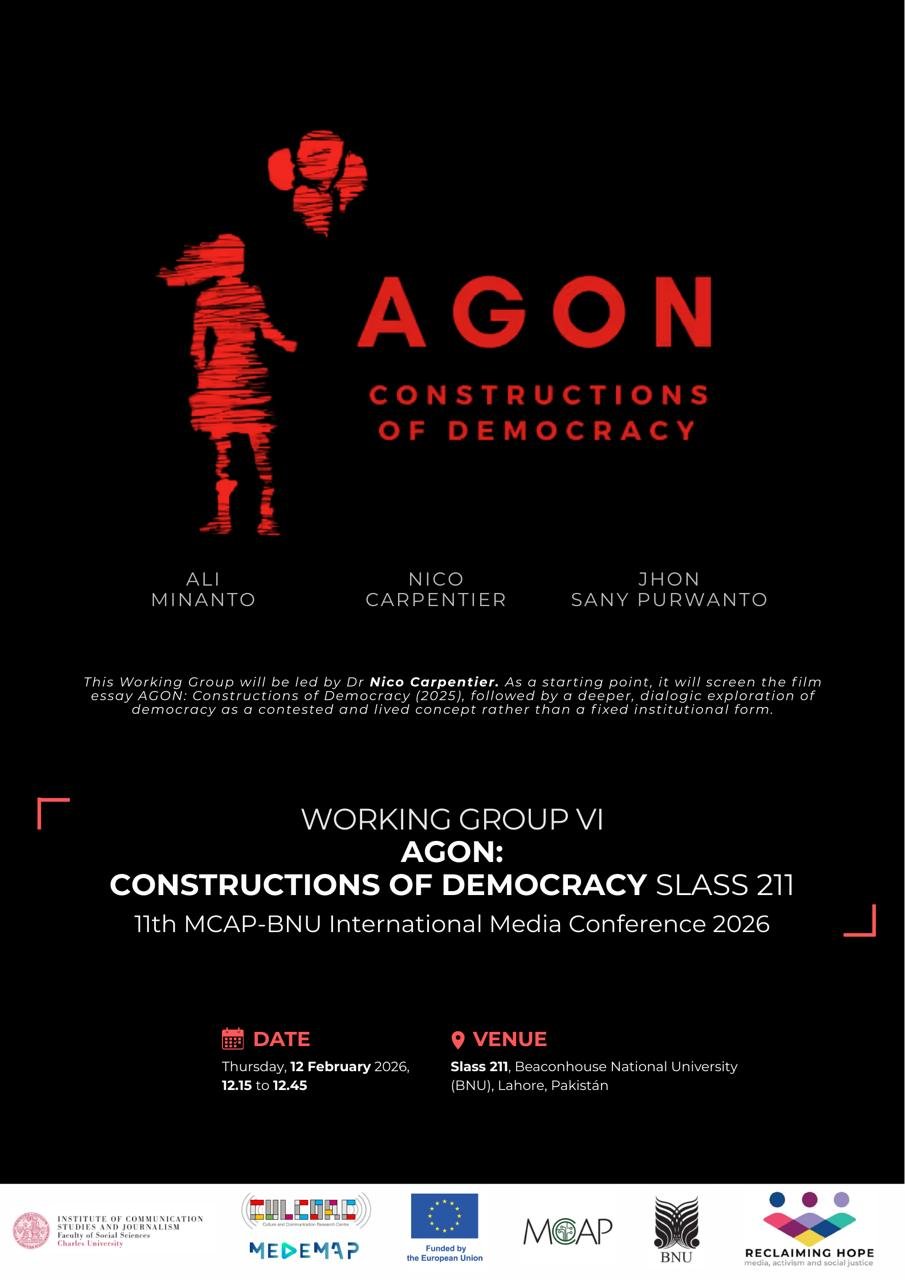
This Working Group will screen the film essay AGON: Constructions of Democracy (2025, 26 minutes), by Ali Minanto, Nico Carpentier, and Jhon Sany Purwanto, as a starting point for a deeper, dialogic exploration of democracy as a contested and lived concept rather than a fixed institutional form. Through an interactive engagement with the film essay, participants will critically reflect on how democracy is imagined, negotiated, and practiced across cultural and social contexts.
The session will be led by Dr. Nico Carpentier and designed as an interactive forum with media academia and media practitioners, moving beyond film analysis to collectively interrogate how democracy is constructed, contested, and communicated in contemporary societies.
Guiding Discussion Questions: AGON – Constructions of Democracy
•Democracy as a Contested Practice:
How does understanding democracy as an ongoing, contested process help reclaim hope in times of political polarization and democratic fatigue?
* Media, Aesthetics & Democratic Imagination:
In what ways can arts-based research, with its deployment of creative repertoires—film, fiction, dance, and visual storytelling—open alternative spaces for democratic engagement and social justice, where also academic can intervene?
* Intercultural Encounters & Lived Democracy:
How do everyday intercultural experiences and migrant narratives reshape dominant ideas of democracy, citizenship, and belonging?
• Media Responsibility, Activism & Agonism:
What role should media practitioners and educators play in sustaining productive disagreement while supporting activism and inclusive democratic dialogue?
Palestinian Interactive Session
February 12 | 11:30–1:30 PM
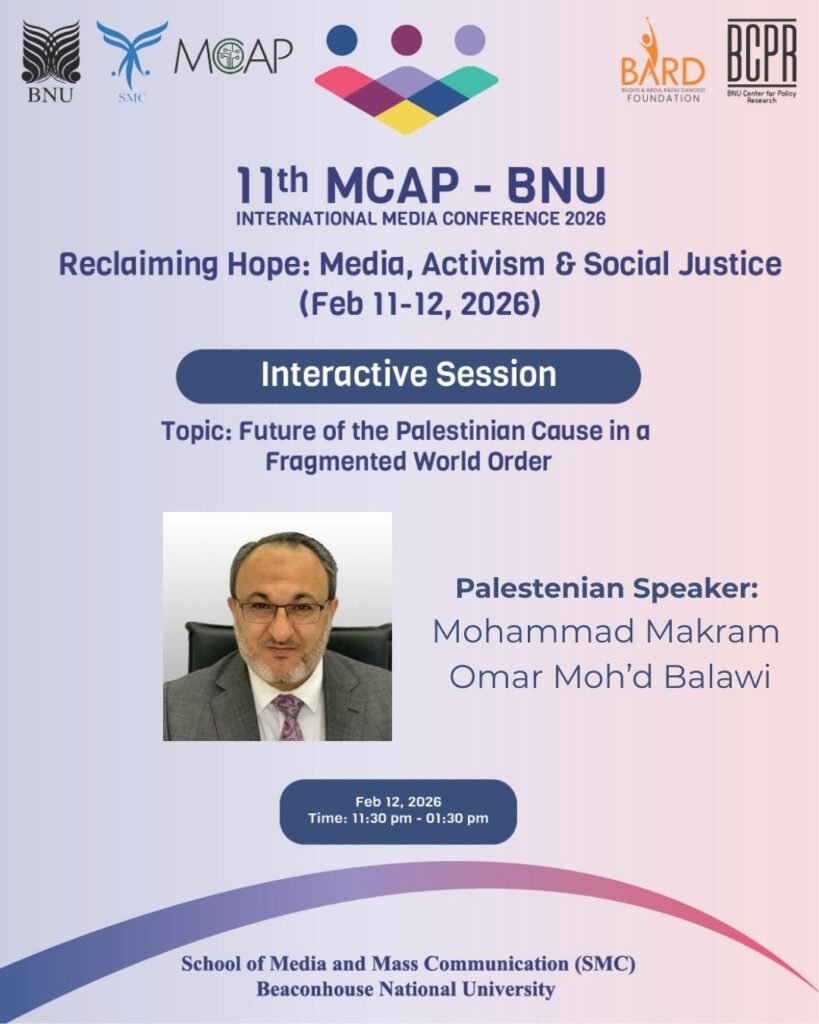
February 12 | 11:30–1:30 PM
Topic: Future of the Palestinian Cause in a Fragmented World Order
Speaker: Mohammad Makram Omar Moh’d Balawi
This interactive session will reflect on the evolving realities of the Palestinian cause within a rapidly shifting and fragmented global order. It will explore how geopolitical realignments, media narratives, digital activism, and international law shape contemporary understandings of justice, solidarity, and self-determination. Possible discussion points include the role of global and regional media in framing the Palestinian struggle, the impact of emerging multipolar politics, the place of civil society and youth-led activism, and the responsibilities of scholars and media practitioners in sustaining informed and ethical engagement. The session aims to foster thoughtful dialogue on how hope, advocacy, and meaningful international attention can be sustained in complex and changing times.
Working Group 4: China–Pakistan Media Collaboration: Evolving Narratives and Opportunities
Feb 12- 1:30- 3:00 pm (SLASS 120)
China-Pakistan media collaboration constitutes a significant dimension of the All-Weather Strategic Cooperative Partnership, extending beyond diplomatic and economic cooperation into the realm of narrative construction, public perception, and mutual understanding. As the China–Pakistan Economic Corridor (CPEC) enters its second decade, media engagement has become increasingly important in shaping how development, partnership, and societal change are understood by publics in both countries. While bilateral relations have traditionally been driven by strategic and economic considerations, information gaps, cultural misperceptions, and externally driven narratives continue to influence public opinion, underscoring the need for more nuanced and credible media collaboration.
This Working Group aims to critically examine the role of collaborative media frameworks in identifying and addressing information asymmetries and cultural misunderstandings surrounding CPEC and broader China-Pakistan relations. It seeks to explore how media cooperation can move beyond state-centric narratives to include societal, cultural, and everyday lived experiences, while remaining sensitive to strategic contexts. A key objective is to assess how joint media initiatives can more effectively engage younger audiences by leveraging digital and social media platforms. The Working Group will also deliberate on sustainable models of collaboration- such as co-produced documentaries, joint newsrooms, training exchanges, and shared fact-checking initiatives that can enhance credibility, independence, and long-term impact. Through focused dialogue, the session aims to generate practical recommendations for strengthening media cooperation in ways that foster trust, authenticity, and deeper people-to-people connectivity.
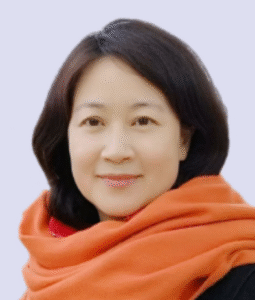
Dr. Zhang Yanqiu
Professor of Communication and Deputy Dean, Institute for a Community with a Shared Future, Communication University of China (CUC), Beijing. Dr. Zhang also directs CUC’s Africa Communication Research Center. With a PhD from Renmin University of China, she specializes in international communication, African media studies, constructive journalism, and public diplomacy. She has published six books and over 70 academic articles, and has visited more than 40 countries for conferences and lectures worldwide.
Mr. Nasir Jamal
Bureau Chief (Lahore), Dawn. An experienced journalist specializing in business and economics, Nasir Jamal writes extensively on Pakistan’s economic landscape, including trade, energy, finance, and policy issues. Based in Lahore, he brings deep expertise in analyzing complex economic developments and their impact on Pakistan’s business environment. His reporting regularly covers critical topics from China-Pakistan economic relations to domestic financial reforms.
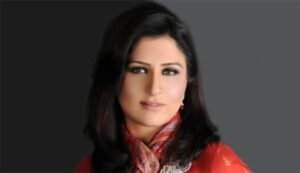
Ms. Fareeha Idrees
Senior Journalist and Anchor, GNN. Host of the prime-time current affairs program News Edge, Fareeha Idrees holds a postgraduate degree in Broadcast and Print Journalism from the University of Westminster, UK. She has worked with The Guardian, BBC, Channel 4, and The Daily Mirror, and previously served as Bureau Chief at CNBC Pakistan. Known for her fearless and transparent journalism, she brings extensive experience from both Pakistani and international media platforms.

Ms Noreen Hu Pingping
Head of Noreen Studio & Associate Senior Translator, Urdu Department, Asia-Africa Center, China Media Group